
What are the benefits?
• Part 1: Search Space Improvement

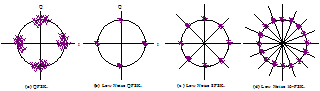
• Part 2: Phase Noise Reduction
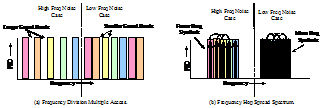
• Part 3: Frequency Reference Improvement
| Part 1 – Search
space improvements: |
|
| During
acquisition the receiving terminal must perform a search of the search space
of frequency, phase, and code to acquire the transmitting terminal signal. |
|
| If there is less noise in these parameters,
the search space is reduced, speeding acquisition. |
|
| Ultra-fast acquisition allows more
efficient “TDMA” style operations,
such as transmit on demand, that use
bandwidth more efficiently. |
|
| Part 2: Phase
noise reductions allow more efficient use of encoding for the same power
(ebno). |
|
| Phase noise
limits the type of modulation and manner of encoding that can be performed in
phase space, commonly used for over the air telecommunication systems. |
|
| HFGW can reduce phase noise by providing a
frequency reference with outstanding stability. |
|
| For example, moving from QPSK to 8PSK or
16-PSK improves bandwidth efficiency by a factor of 2 to 4 |
|
| Part 3:
Frequency Stability Improvements |
|
| Frequency noise
limits the type of modulation and manner of encoding that can be performed in
frequency space, such as FDMA or FHSS. |
|
| HFGW can reduce frequency noise by
providing a frequency reference with outstanding stability. |
|
| For example, guard bands can be shrunk in
FDMA, and frequency slices can be smaller and more stable in FHSS. |
|
| . |
|